AI Automation Is Designed Backwards
Most AI automation starts with what the technology can do, not with what a business is willing to delegate. The right unit of automation is responsibility.
 The FrontSail AI team6 min read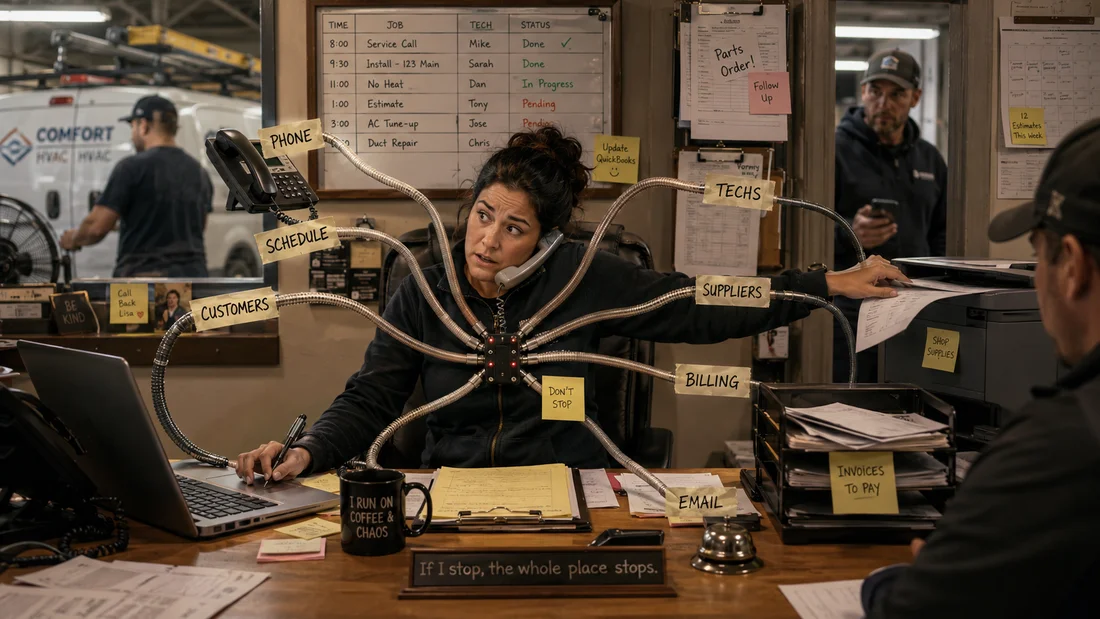
A contractor sits through an AI demo.
The salesperson explains that the system can summarize calls, write emails, update records, schedule appointments, generate invoices, and probably compose a tasteful haiku about overdue payments.
The owner asks a simpler question:
“Can it make sure every customer asking for a quote actually gets called back?”
The demo suddenly becomes less impressive.
The AI can complete each individual step. It can summarize the call, create the customer, draft a message, and add a reminder. But can it make sure the opportunity does not disappear between the person answering the phone, the estimator driving between jobs, and the sticky note attached to someone’s coffee mug?
Most AI automation is designed backwards. It starts with what the technology can do instead of what the business is willing to delegate.
Businesses do not think in features
AI products are usually sold as capability lists: calls, messages, scheduling, CRM updates, quotes, analytics, integrations.
Then the owner receives a workflow builder and is invited to assemble an employee.
That may appeal to technical teams with time and a suspicious enthusiasm for flowcharts. It is less useful to a roofer whose team is currently standing on roofs.
Business owners do not think, “I need automated intent classification.” They think, “Emergency calls should not sit beside questions about Saturday hours.”
They do not want more technology to operate. They want responsibilities taken off their plate.
A task is not a responsibility
“Summarize this call” is a task.
“Make sure the estimator understands what the customer needs without making them explain everything again” is a responsibility.
“Create a customer record” is a task.
“Make sure every real lead is recorded, assigned, and followed up” is a responsibility.
Tasks produce outputs. Responsibilities produce outcomes.
A system can complete every task perfectly while leaving the business with the same problem. The call was summarized. The lead was entered. The reminder was created.
Nobody called the customer.
Technically, the automation succeeded. Commercially, everyone lost. It is the same gap we wrote about before: the call is over, but the work is not.
The right question is not:
“What can AI automate?”
It is:
“What responsibility am I ready to stop carrying?”
Features do not remove responsibility
This is where many automation projects disappoint.
A company transcribes every call. Now someone must read the transcripts, which is not the same thing as knowing what customers are asking for.
It detects sales leads. Now someone must check whether those leads were contacted.
It drafts follow-up messages. Now the business has beautifully written messages waiting to be sent.
The company has become more technologically impressive without becoming less dependent on the owner.
A small business does not need ten automated steps. It needs one responsibility it can stop worrying about.
Consider a simple responsibility:
Make sure every urgent service request reaches the right person.
That means understanding what happened, collecting the address and relevant details, identifying who is on call, passing along useful context, and escalating when nobody responds.
The customer does not care how many integrations were involved. They care that water is entering the basement and somebody is actually coming.
Delegation needs boundaries
Responsibility does not mean unlimited authority.
A useful assistant should handle routine, reversible work automatically: organize the request, collect information, create a draft work order, notify the right person, and flag forgotten follow-up.
It should involve a human before changing prices, issuing refunds, cancelling jobs, or making unusual promises.
The assistant should not ask permission to move every comma. It also should not promise that Mike will arrive in twelve minutes when Mike is two towns away buying pipe fittings.
The goal is not maximum autonomy. It is useful autonomy.
Routine work should happen routinely. Exceptions should reach a person.
AI should earn responsibility
Nobody gives a new dispatcher control over the entire company on Monday morning. At least, nobody should.
You give them a clear role, explain the rules, review the work, and expand their responsibility as trust grows.
AI should work the same way.
Start with one visible, painful responsibility:
Handle the calls we miss and make sure real opportunities reach us.
Review what it understood, what it escalated, and whether the team acted. When it works reliably, give it more responsibility.
Not because another feature was switched on. Because trust was earned.
Software should accept work
Traditional business software stores things.
A CRM stores leads. A calendar stores appointments. Dispatch software stores jobs. A whiteboard stores today’s schedule until someone accidentally erases Johnson’s furnace repair.
And somewhere between them, the owner remembers that all these records describe the same customer. In many small businesses, the integration layer is a person.
The next generation of software should do more than store work and wait for another click. It should accept responsibility.
The owner should be able to say:
“Make sure every real quote request is captured and followed up.”
The assistant should understand the outcome, work across the tools already in use, handle normal cases, and surface exceptions.
That is less like operating software.
It is more like delegation.
How FrontSail AI approaches it
FrontSail AI begins with a recognizable responsibility: handle customer conversations the business would otherwise miss.
But answering the call is only the beginning. The larger job is to understand what the customer needs, collect useful information, recognize urgency, route the request, and keep the work visible until someone handles it.
FrontSail AI is not meant to become a bag of unrelated AI tricks.
The vision is a virtual operations assistant that works across the tools a business already uses and takes responsibility for routine work the owner chooses to delegate.
It starts narrow, proves itself, and earns more responsibility.
The next time someone shows you everything AI can do, do not ask how many features it has.
Ask:
“What responsibility can I stop carrying?”
Businesses do not need AI that can do everything.
They need an assistant that reliably takes something off their plate.
Start with one responsibility, not twenty features
Businesses do not need AI that can do everything. They need an assistant that reliably takes something off their plate.
With FrontSail AI, you can create a virtual assistant that handles the calls and messages you would otherwise miss: it understands what the customer needs, collects the intake, recognizes urgency, routes the request, and keeps unresolved work visible until somebody owns it.
Pick the one responsibility you are most tired of carrying. Define what the assistant may do on its own, what needs your approval, and when it should escalate. Then watch it work before you hand over anything else.