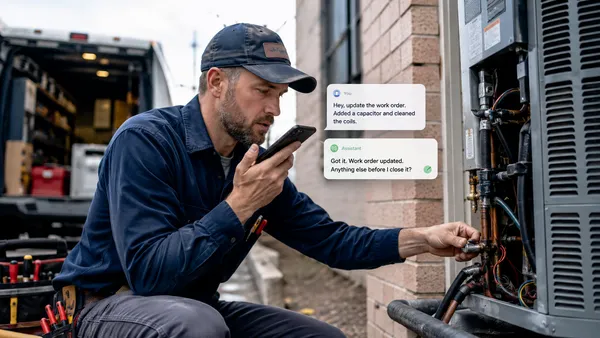
The Call Is Over. The Work Is Not.
Answering the phone is not the same as handling the work. Here is why business calls leak after the conversation ends, and how to capture the commitment instead of relying on memory and sticky notes.
 The FrontSail AI team5 min read
A few weeks ago, I called an auto shop to book an appointment.
Nothing dramatic. No smoke coming out of the engine. Just a normal “can I bring the car in later today to change the oil?” kind of call.
The person on the phone said yes. We agreed on 5 PM.
Great!
Appointment booked.
Or so I thought.
About three hours later, the shop called me back and asked:
“Hey, was it you who booked an appointment for 5?”
That is when I realized what probably happened.
Someone answered the phone in the middle of work. They confirmed the appointment. They planned to write it down later. Then reality did what reality does best: interrupted everything.
Two hours later, they had an appointment on the edge of existence, no clear customer attached to it, and a phone history full of suspects.
This is not rare. This is business operations on a Tuesday.
And this is the point: answering the phone is not the same as handling the work.
The front door is only the beginning
In the last two posts, we talked about the front door of the business: voicemail loses opportunities, and IVRs lose customer intent.
But there is another leak: the call happens, the customer explains the problem, someone agrees to the next step, and the business still drops the ball.
Answering the phone solved the front-door problem.
It did not solve the follow-through problem.
Every call creates work
A business call is rarely just “a call.”
It may create an appointment, callback, quote request, service task, reschedule, complaint, or follow-up reminder.
Sometimes the commitment is obvious: “You’re booked for 5 PM.” Sometimes it is softer: “someone will call you back,” “we’ll send a quote,” or “I’ll ask the service team.”
Either way, the call created work.
If that work is captured clearly, great. The business can act on it. If it only lives in someone’s head for “just a minute,” good luck. That minute has teeth.
Someone gets interrupted. Another customer walks in. A technician asks a question. The phone rings again. The computer decides this is the perfect moment to update.
Suddenly, the 5 PM appointment is floating around the shop like a ghost with a loose oil filter.
If this can happen with a simple oil change, imagine what happens with quote requests, urgent repairs, warranty questions, complaints, and callbacks.
This is where businesses quietly leak work. Not because people do not care, but because people are busy.
Memory is not a process
Every busy business has a version of this sentence:
“I’ll write it down in a second.”
“I’ll add it after this job.”
“I’ll remember.”
Famous last words.
The problem is not irresponsibility. The problem is that the conversation and the system are often separate worlds.
The customer thinks:
“I booked an appointment.”
The business reality may be:
“Someone agreed to it on the phone and planned to record it later.”
That “later” is where things fall apart.
Someone still has to move the commitment into the system the business actually runs on: a calendar, CRM, dispatch board, spreadsheet, notebook, or task list. In a busy shop or service business, that person is usually already juggling five things.
That is not much of a system.
It is a business running on memory and good intentions.
Very human.
Not very scalable.
A better process turns the call into something visible: who called, what they needed, what was promised, who owns the next step, and when it needs to happen.
The goal is simple: business commitments should live in a system, not in someone’s memory.
Memory is great for birthdays, childhood songs, and the exact location of a snack you hid from your kids.
It is less great as the central database for business commitments.
How FrontSail AI helps
This is why a Frontdesk assistant is not “just answering calls.”
Answering the phone when your team is busy is useful on its own. But the bigger shift is what happens to the conversation afterward. Instead of evaporating into call history, it gets written down somewhere the rest of the team can act on it.
Instead of:
“Someone called about something. Maybe oil change? Maybe 5 PM? Check phone history.”
You get:
“Alex called to book an oil change today at 5 PM. He confirmed the appointment time and wants to be called if there is any delay.”
That is a completely different business experience.
Frontdesk captures the conversation. Backoffice automation helps move the work forward through tasks, reminders, callbacks, summaries, and context.
The quote that was never sent. The appointment that was not written down. The callback that waited too long. The customer who had to explain the same thing twice.
Those are not just phone problems.
They are operations problems.
Start where memory already fails
You do not need to automate everything on day one. Please do not.
Start where the current process already breaks: calls taken while someone is busy, appointments confirmed verbally, callbacks written on paper, quote requests sitting in inboxes, reschedules passed through text messages, and customer details trapped in call history.
Ask one simple question:
What happens after a customer calls?
If the answer is mostly “someone remembers,” you do not have a process.
You have a person carrying the process.
That person may be excellent.
They are still not a database.
The call is only the beginning
A customer call is not just a communication event. It is the beginning of work.
The difference between “we answered the call” and “we handled the customer” is whether the promise stays visible until it is done.
Because the call is over.
But the work is not.
Stop relying on memory after the call
A call is not done when the conversation ends. It is done when the next step is captured, assigned, and remembered.
With FrontSail AI, you can create a virtual Frontdesk assistant that captures customer calls, summarizes what happened, and helps your team follow up with context.
Start with the calls your team misses, the calls they answer while busy, and the appointments, callbacks, and quote requests that currently rely too much on memory.