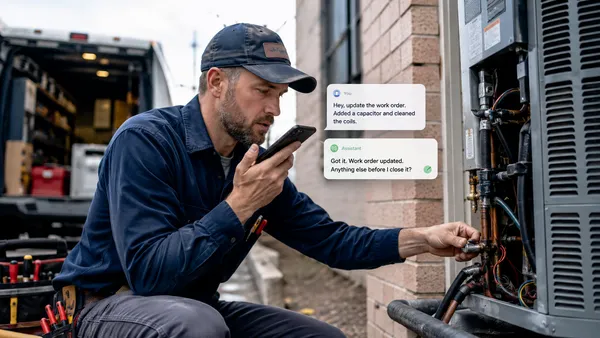
Your AI Agents Work for Their Apps. Who Works for Your Business?
Every app is getting an AI agent. Each is right about its own slice and blind to the whole job. Someone still has to work for the business, not the software.
 The FrontSail AI team9 min read
A homeowner messages an HVAC company on Instagram:
“Our furnace stopped working. Can someone come tomorrow?”
The messaging agent collects her address and phone number. The CRM agent creates a lead. The scheduling agent books a visit.
So far, the future looks magnificent.
The next morning, the customer calls to move the appointment. The phone agent records the change. Later, the technician discovers a failed blower motor and dictates his notes into the field-service app. Its AI updates the work order. The accounting agent starts preparing an invoice.
Then the customer sends another message:
“Did the part arrive, and are you still coming Thursday?”
Now things become less magnificent.
The messaging agent knows about the original inquiry. The phone agent knows about the reschedule. The field-service agent knows about the part. The scheduling agent knows about Thursday. The accounting agent knows that no deposit has been paid.
Every agent knows something.
Nobody knows the job.
So the owner opens four apps, checks two message threads, calls the technician, and reconstructs reality by hand.
Congratulations. The business now has an AI workforce.
The owner has been promoted to its unpaid middle manager.
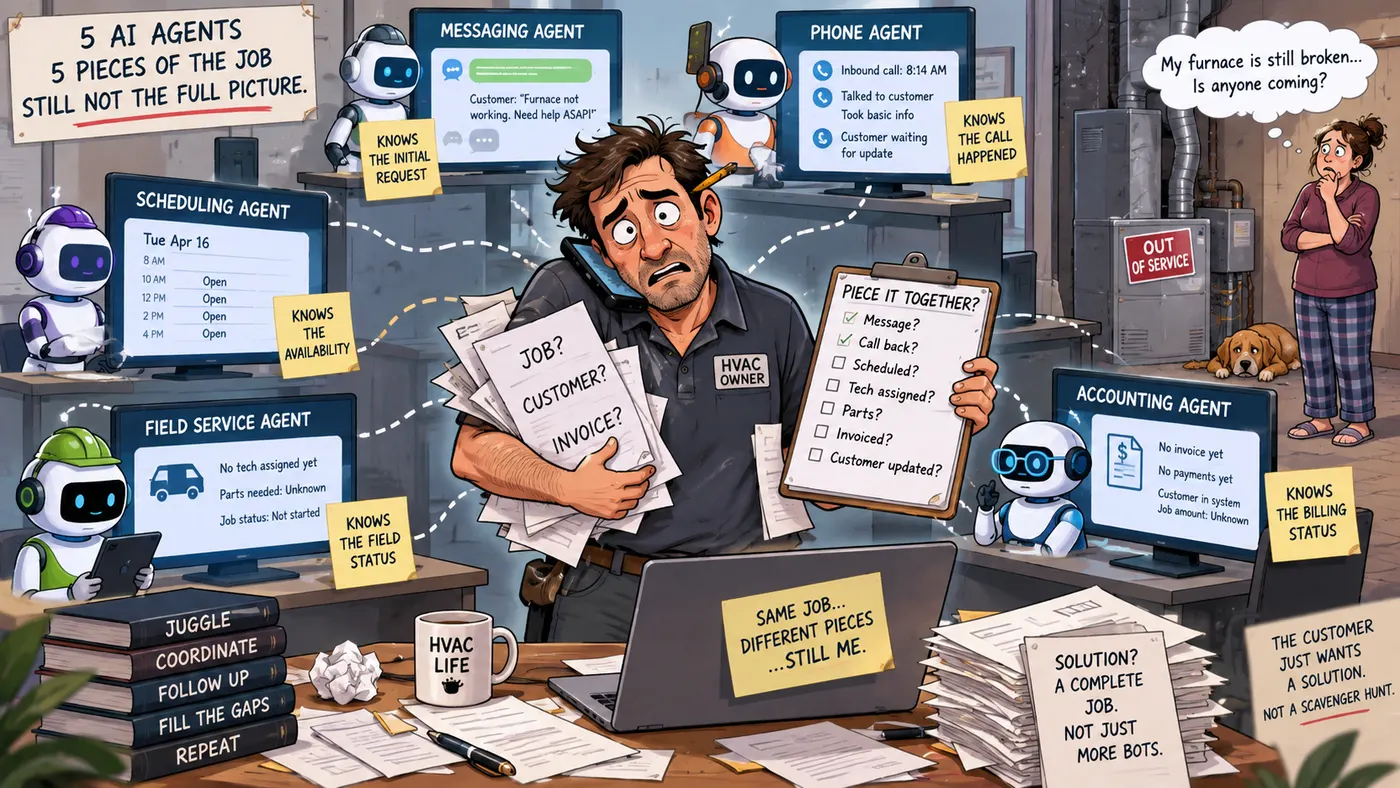
Five agents, five fragments of the same job. The owner is the only one holding all of them.
Every app is hiring an agent
This is no longer a theoretical problem.
On September 8, 2026, Meta launched Muse, a personal agent that can open a browser, fill in forms, send email, book travel and make purchases on someone’s behalf. The following day, it acquired the Stockholm startup Stilla.ai to accelerate Meta Business Agent, the system already used by more than a million businesses to handle customer conversations across WhatsApp, Messenger and Instagram.
Meta will not be alone. Your CRM will have an agent. Your calendar will have one. Your accounting software, phone system, advertising platform and field-service application will all politely introduce their new AI employee. Every one of them is an agent for its own software.
Each may be genuinely useful.
There is only one problem:
Those agents work for their applications. Nobody works for the business.
The CRM agent sees a lead. The scheduling agent sees an appointment. The accounting agent sees an invoice. The messaging agent sees a conversation.
The customer sees one job.
Every agent can be right while the business is wrong
Imagine that every specialist agent performs perfectly.
The lead was created. The appointment was edited. The work order was updated. The invoice remained in draft because the job was not marked complete.
Green checkmarks everywhere.
The customer still has no idea whether anyone is coming.
This is the next generation of software fragmentation. We are not removing the silos. We are giving each silo a chatbot and hoping they become friends.
They will not automatically become friends.
An intelligent agent holding one fragment of context can still produce a confidently useless answer.
It might tell the customer:
“Your appointment is scheduled for Tuesday.”
The scheduling system says Thursday.
Or:
“Your invoice is being prepared.”
The replacement part has not even arrived.
The agent did not malfunction. It answered correctly from the narrow window through which it sees the business.
That is not intelligence at the company level. It is several intelligent departments with no staff meeting.
A digital crew still needs a foreman
A job site may have an electrician, a plumber, a carpenter and an HVAC technician.
Each is a specialist. Nobody expects the electrician to install the furnace, or the plumber to rewire the panel, because “we are all one team.”
But specialists still need coordination. Someone must understand the whole project, sequence the work, resolve conflicts and make sure the promised result is delivered.
AI agents are no different.
The accounting agent may be best at preparing an invoice. The scheduling agent may be best at finding an appointment. The messaging agent may be best at communicating through its channel.
A business-level assistant does not need to replace them.
It needs to manage the job around them. Performing a step is a task. Owning the outcome is a responsibility, and responsibility is the thing a business actually wants to hand over.
A channel agent knows the conversation. An app agent knows its software. A business assistant knows the customer, the job, and what must happen next.
Access to the company’s data is not enough on its own. The assistant has to understand how this particular business runs: its service area, its hours, its pricing, its exceptions.
It should know that emergency calls receive priority, that unusual discounts require approval, that Mike does not work Fridays, and that promising a fifteen-minute arrival would require either a helicopter or a lie.
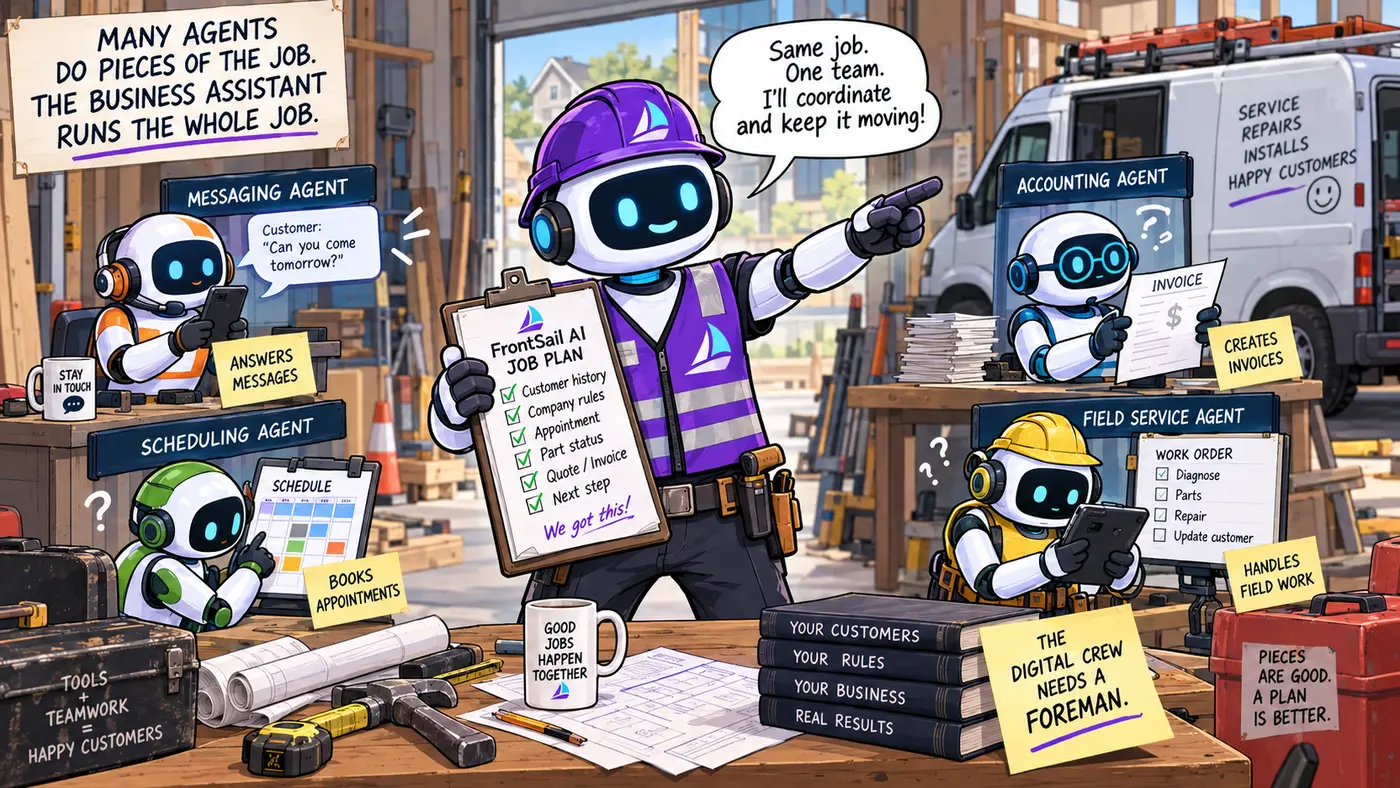
The business assistant owns the outcome
Return to the customer asking about Thursday.
A business-aware assistant can check the work-order system for the part, the scheduling system for the appointment and the accounting system for the deposit. It can compare those answers with the company’s policies and respond:
“The part arrived this afternoon, and your appointment is still scheduled for Thursday between 9 and 11. No additional payment is required before the visit.”
One question. One reliable answer.
The customer does not need to understand the company’s software org chart. The owner does not need to conduct a small internal investigation.
The same principle applies behind the scenes.
A technician can dictate what he found on site. The business assistant carries that context to the work order, asks the appropriate specialist system to prepare a quote, and presents it to the owner for review. When the work is complete, it can coordinate the invoice, the customer update and the follow-up.
The specialist agents perform their pieces.
The business assistant makes sure the pieces become a finished job.
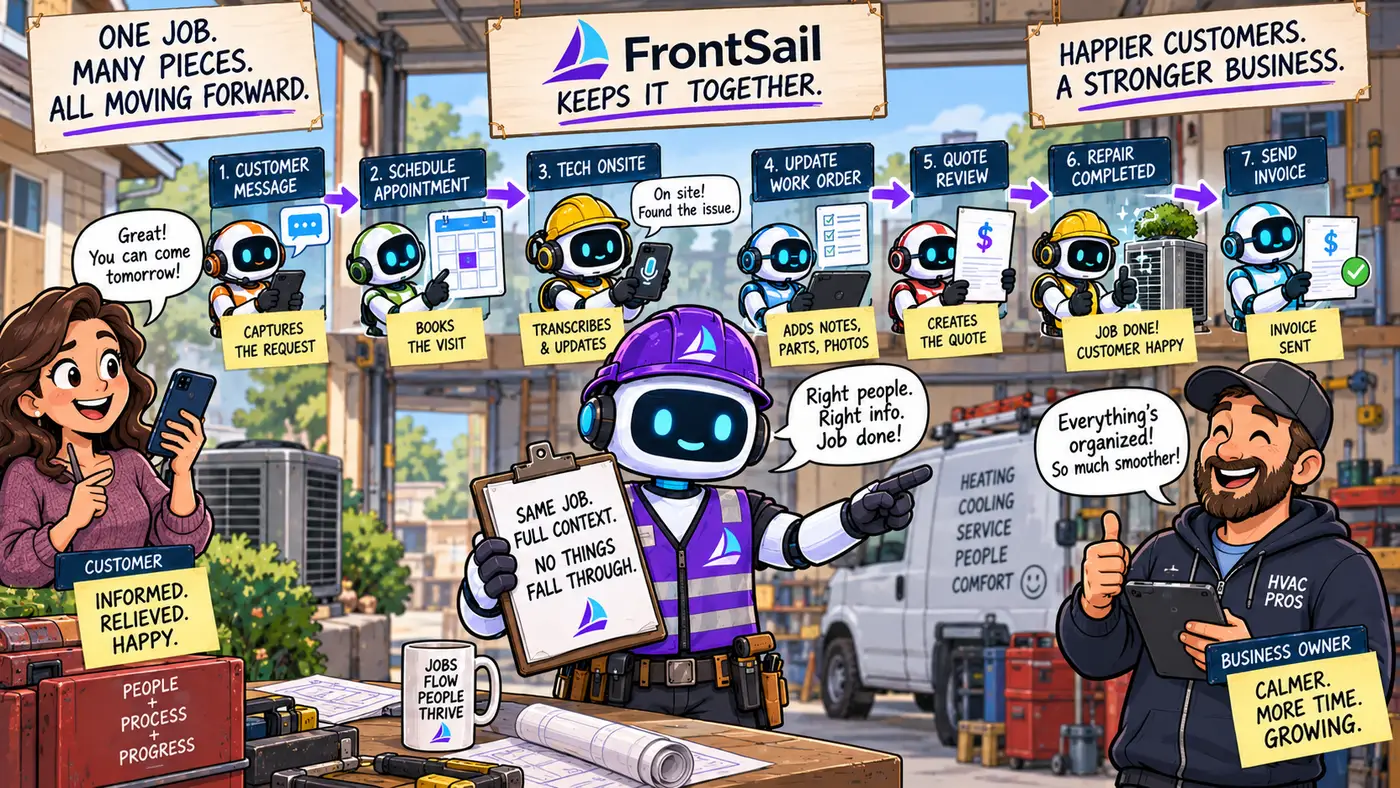
One customer, one job, one thread of context, carried through every system that touches it.
The platforms know this too
It would be comfortable to claim that nobody else has noticed.
They have. Stilla.ai was bought for an agent that retains company context and acts across the tools a business already uses. The chat interface was incidental. That is a coordination layer, and Meta is now pointing it at commerce inside its own messaging apps.
Which is exactly the catch.
A coordination layer that lives inside one platform coordinates what that platform can see. It is superb at the conversations, payments and catalogue that belong to it. It does not know that Mike is off on Fridays, that the Hamilton supplier is late again, or that this customer’s landlord must approve the work before anyone is dispatched.
The question is not whether a coordination layer will exist. It is whose business it is coordinating for.
FrontSail AI is the foreman
FrontSail AI is built to be the business assistant in this picture.
It starts at the front desk, because that is where customer work enters the business. A call, a web chat or a message does not become three unrelated records in three unrelated tools. It becomes one customer request whose context follows the job.
Today, FrontSail AI answers customer conversations, captures structured intake, applies business rules, and moves requests into appointments, customer records, work orders and invoice preparation. It sits across the tools a service business already uses, rather than demanding another painful migration.
As those tools grow their own agents, FrontSail AI treats them as the crew. It hands each specialist agent the work it understands best, collects the result, applies the company’s rules, and keeps ownership of the outcome.
Not one enormous AI pretending to be an accountant, dispatcher, marketer, receptionist and master electrician before lunch.
One manager, working for the business, coordinating a digital crew.
That is the job FrontSail AI was built for.
The next software problem is management
Small businesses spent the last fifteen years collecting applications.
They may spend the next five collecting AI employees for those applications.
Without a management layer, the owner remains responsible for connecting everything: explaining the same customer to every system, checking whether actions actually happened, and resolving contradictions when the agents disagree. In many small businesses, that management layer is already a person. Adding AI to every app makes that person’s job harder.
We will have automated every individual step and somehow preserved all of the supervision.
That is not the future businesses need.
The future worth building is one assistant that understands the business well enough to make every application, and every agent inside it, work toward the same result.
Your digital crew is arriving.
Make sure someone is working for the business.
Your digital crew needs someone working for the business
Specialist agents are arriving whether you asked for them or not. What is missing is the layer that owns the outcome.
FrontSail AI starts where customer work enters the business: calls, web chat and messages. It captures what the customer actually needs, applies your rules, and keeps the request visible until somebody owns it, instead of scattering the same job across four tools that never speak to each other.
Pick the one customer request that currently requires you to open four apps to answer. Start there.