Your Phone Report Tells You How Many People Called. Not Why.
Call reports count what happened to the phone, not what customers wanted. Here is how to turn everyday conversations into demand a business can act on.
 The FrontSail AI team 7 min read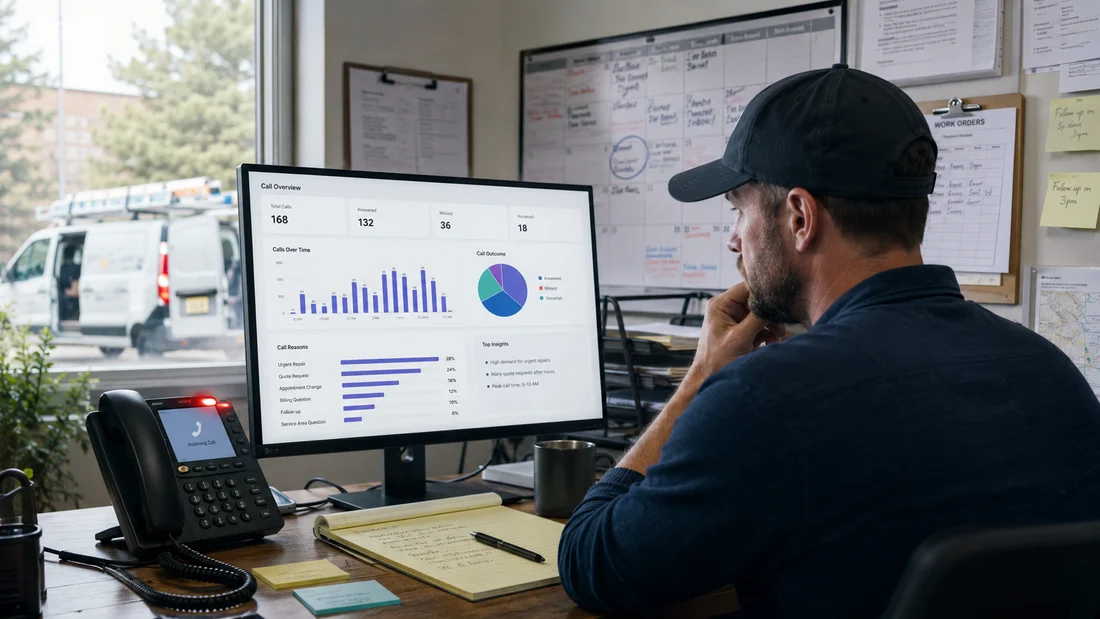
Every month, somewhere in a small business, an owner receives a phone report.
It looks official.
There are charts. Percentages. Green arrows. Maybe even a pie chart, because apparently no business report is complete until somebody slices a circle into seven colours.
The report says:
- 186 calls received
- 31 calls missed
- average duration: 3 minutes and 42 seconds
- busiest day: Tuesday
- longest call: 17 minutes
Very impressive.
Now comes the only question that matters:
What did those people want?
The report does not know.
It knows that somebody called at 2:14 p.m. It knows the call lasted six minutes. It may know which employee answered.
But it does not know whether the caller wanted a $20,000 window replacement, needed to reschedule an appointment, had water leaking through the ceiling, or was trying to sell toner.
To the phone system, those are all six-minute calls.
To the business, they are not remotely the same thing.
Call volume is not demand
Traditional phone analytics explain what happened to the call.
Was it answered? How long did it last? Which department received it? Did the caller hang up while listening to music nobody has ever chosen voluntarily?
These metrics are useful. They show whether calls are being missed, when the team is busiest, and whether the phone channel is working.
But they describe the phone, not the business.
A company does not make money because the phone rang 186 times.
It makes money because some of those calls were quote requests, service jobs, bookings, complaints that could still be recovered, and customers ready to buy.
The phone report measures activity.
The business needs to understand demand.
Every conversation contains a signal
Imagine a roofing company receives these calls:
“There is water coming through the ceiling.”
“How much would it cost to replace the roof next spring?”
“Do you work in Guelph?”
“Your crew was supposed to arrive an hour ago.”
“Can I move my appointment to Friday?”
A conventional report sees five incoming calls.
The business should see:
- one urgent service request;
- one future sales opportunity;
- one signal of geographic demand;
- one customer-experience problem;
- one scheduling task.
Customers are constantly telling you:
- what they want;
- what is broken;
- what they are confused about;
- what your website failed to explain;
- which services are growing;
- where your process is leaking.
Most businesses already have this information.
It is simply trapped inside recordings, notes, inboxes, CRM fields, and the heroic memory of whoever answered the phone.
The best analytics platform is often an employee
Ask an experienced receptionist what customers have been calling about lately.
She may say:
“We are getting lots of heat-pump calls.”
“People keep asking whether we serve Cambridge.”
“Customers are annoyed because nobody calls back after an estimate.”
“Most emergency calls come after five.”
That is valuable business intelligence.
It can affect advertising, staffing, website content, training, and service areas.
Unfortunately, it often stays inside one person’s head. They mention it once near the coffee machine, then return to answering calls.
The company has the data. It just cannot see it clearly.
And when that employee goes on vacation, the analytics department goes with them. We wrote about that pattern before: in many small businesses, the integration layer is a person.
Answering every call is not enough
Businesses worry about missed calls, and they should.
A missed call can quickly become a job for a competitor.
But there is a comforting myth that once someone answers, the opportunity is safe.
It is not.
The caller explains the problem. Someone writes down a name and number. The note lands on a desk, in a chat, or somewhere inside human memory.
Then the day continues.
Three more customers call. A technician needs help. An invoice is wrong. Somebody asks where the ladder is.
The note waits patiently for its archaeological discovery.
The business did not miss the call.
It missed the work created by the call.
Answering prevents one kind of loss. Understanding and following up prevent the rest. That is the difference between the call being over and the work being done.
Transcripts are not analytics
One possible solution is to transcribe every call.
Technically, the business now has more information.
Practically, it has created a new job: reading hundreds of transcripts.
That is not analytics. That is punishment with searchable text.
The useful question is not:
“Can I read every call?”
It is:
“Can I see what customers are asking for across all calls?”
A useful demand view should answer:
- Why are customers contacting us?
- Which conversations are sales opportunities?
- Which requests are urgent?
- Which services are growing?
- Which issues keep repeating?
- Which customers are still waiting?
- What are people asking for that we do not offer?
That is when conversations stop being an archive and become an operational signal.
The valuable part is what changes next
Analytics matter only when they change a decision.
Suppose an HVAC company discovers that emergency calls spike after 6 p.m.
That may justify better after-hours coverage.
Suppose a flooring company sees that customers repeatedly ask whether it removes old flooring.
That answer should probably be clearer on the website and during intake.
Suppose a windows and doors company receives many quote requests, but too many wait two days for a callback.
The problem is not lead generation. The problem is follow-up.
Suppose a plumbing business notices growing demand in a nearby city.
That may affect staffing, service areas, and advertising.
None of these decisions come from knowing Tuesday had the most calls.
They come from understanding why Tuesday was busy.
Conversations are the front edge of operations
A customer call is rarely the final event.
It usually creates work:
- prepare a quote;
- schedule a visit;
- collect photos;
- update a customer record;
- notify a technician;
- check an invoice;
- call somebody back;
- escalate an urgent issue.
This is why customer conversations should not live in a separate universe called “the phone system.”
They are the beginning of business workflows.
The useful progression is:
Conversation → understood demand → structured work → completed outcome
That is a better model than:
Conversation → recording → forgotten recording
From phone analytics to demand intelligence
FrontSail AI is built around this shift.
Instead of showing only that a call happened, FrontSail AI helps businesses understand what the customer wanted, how urgent it was, what category it belonged to, and what still needs attention.
Across calls and messages, that means making demand visible:
- new quote requests;
- service problems;
- appointment changes;
- complaints;
- billing questions;
- unresolved follow-ups;
- repeated customer needs.
Over time, the same understanding can help move the work forward by updating records, assigning tasks, scheduling actions, and supporting follow-up.
The point is not another decorative dashboard.
The point is to stop opportunities from disappearing into operational fog.
The number is not the story
At the end of the month, the old report may still say:
186 calls received.
A useful system should say:
- 47 new quote requests;
- 18 urgent service calls;
- 12 appointment changes;
- 9 billing questions;
- 7 unresolved complaints;
- 14 opportunities still waiting for follow-up.
Now the owner can make a decision.
The first report describes the phone.
The second describes the business.
Knowing that customers called is useful.
Knowing what they want is how you run the company.
See what customers are actually asking for
Knowing that customers called is useful. Knowing what they want is how you run the company.
With FrontSail AI, you can create a virtual Frontdesk assistant that answers calls and messages, captures what each customer needed, and makes the demand behind those conversations visible to your team.
Start with one month of calls. Look at what people asked for, which requests were urgent, and how many are still waiting for a follow-up.