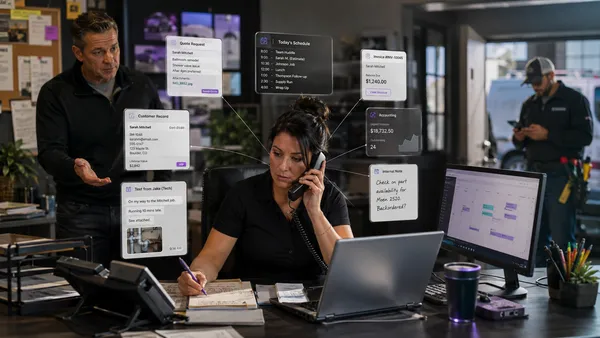
The Lights-Out Office: A Day in 2033
What could you build if growing your business no longer meant growing your evening workload?
 The FrontSail AI team8 min read
Part 1 of the Lights-Out Office series.
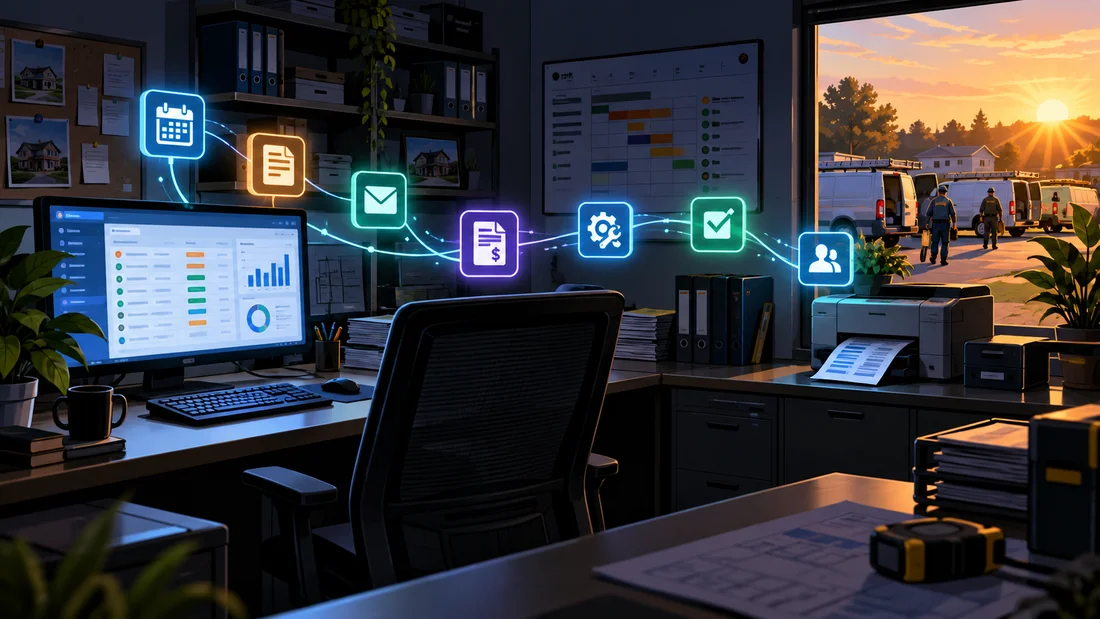
It’s 2033. Your office has already started.
Imagine one possible workday, seven years from now.
You run a heating-and-cooling business with three crews. It is 7:12 a.m. You are drinking coffee, and the office has one question for you.
Not twenty notifications. Not a cheerful reminder that you have seventeen overdue tasks.
One question.
A supplier has delayed equipment for tomorrow’s installation. Your assistant has checked the alternatives and prepared a revised plan. The customer can accommodate the new date, but temporary heating would cost more than the assistant is authorized to approve. Do you want to cover it?
You make the decision. The office handles the consequences.
Meanwhile, an overnight appointment change has been confirmed with another customer. The crew’s schedule and work order reflect it. Yesterday’s completed jobs have moved through the appropriate invoicing steps, and verified payments have been matched to their records.
You can inspect what happened. You do not have to make each thing happen.
By eight, you are helping a newer technician work through a difficult diagnosis. Later, you will interview someone who could lead a fourth crew.
Your attention is going into the business, not into explaining to three applications that Thursday has become Friday.
The job creates the paperwork. You don’t.
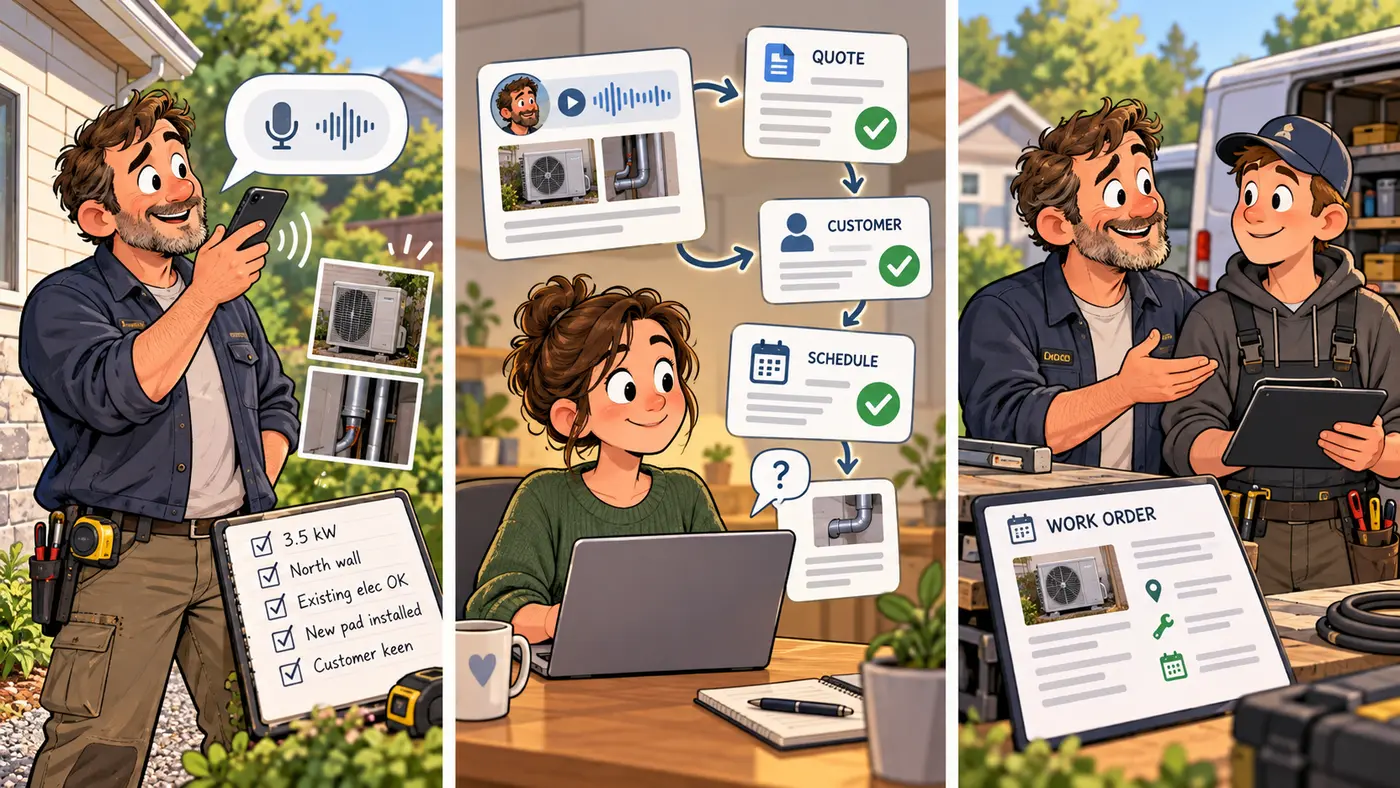
At an assessment, you discuss a heat-pump installation with a homeowner. Before leaving, you send your assistant photographs, measurements, and a voice note:
“Here’s the agreed scope. Include removal of the old unit. Standard payment terms.”
The assistant associates the information with the right customer and prepares the quote using your approved pricing and terms. Anything genuinely missing becomes a focused question. It does not become an imaginative new line item.
Once the quote is approved and accepted, the office carries the job forward: scheduling, work-order preparation, customer confirmation, and the information the crew needs.
You did not have to remember to initiate each step.
When the installation is finished, the crew reports completion and uploads photographs through the messaging channel they already use. The office checks the required information, coordinates invoicing, and follows the job through payment. Later, maintenance follow-up happens according to the customer’s service arrangements.
Some customers still call. Others message. A few have their own assistants coordinate an appointment with yours, within the permissions each side has granted.
People contribute expertise, decisions, and facts from the field. The office handles the administrative consequences.
An office you don’t have to operate
Manufacturing has a term for production that can continue without constant human attendance: lights-out manufacturing. The machinery does not need the lights on to keep working, although people still have responsibilities for setup, maintenance, oversight, and exceptions.
What happens when we apply that idea to office work?
A lights-out office carries administrative workflows from request to completion without someone continually initiating, connecting, and checking every step. It works within the business’s rules and brings people in when their judgment or authorization is needed.
The “office” might never have been a room. Perhaps yours is a calendar, customer records, accounting software, several message threads, and whatever you are currently trying not to forget.
The ambition is not merely to give those tools a conversational interface. Replacing “click here” with “tell the chatbot to click here” still leaves you remembering what needs doing.
The ambition is to delegate the work.
You still run the company. You stop being the mechanism that keeps every routine process moving.
The beginnings are already visible
This direction is no longer confined to future scenarios. In September 2026, Meta introduced Muse, an agent designed to work across applications, continue tasks after the user closes the app, and communicate through WhatsApp. Its subsequent Muse for Small Business announcement added connections to business tools and accounts.
OpenAI’s dots announcement describes always-on agents with their own cloud computers and connected applications, alongside a preview of specialist agents taking on defined organizational responsibilities.
Our reading is straightforward: the conversation is moving from software that answers questions toward software entrusted with ongoing work.
Announcements are not proof that a dependable autonomous office already exists. But they make this a practical direction to explore, not simply an excuse to put “2033” above a picture of a glowing robot.
The harder question is how these capabilities become one coherent operation.
Your tools stay separate. Your business doesn’t.
In our imagined business, the assistant has not replaced every application.
The accounting platform still maintains the financial records. Customer and job information lives in the appropriate systems. A specialist marketing service runs the advertising.
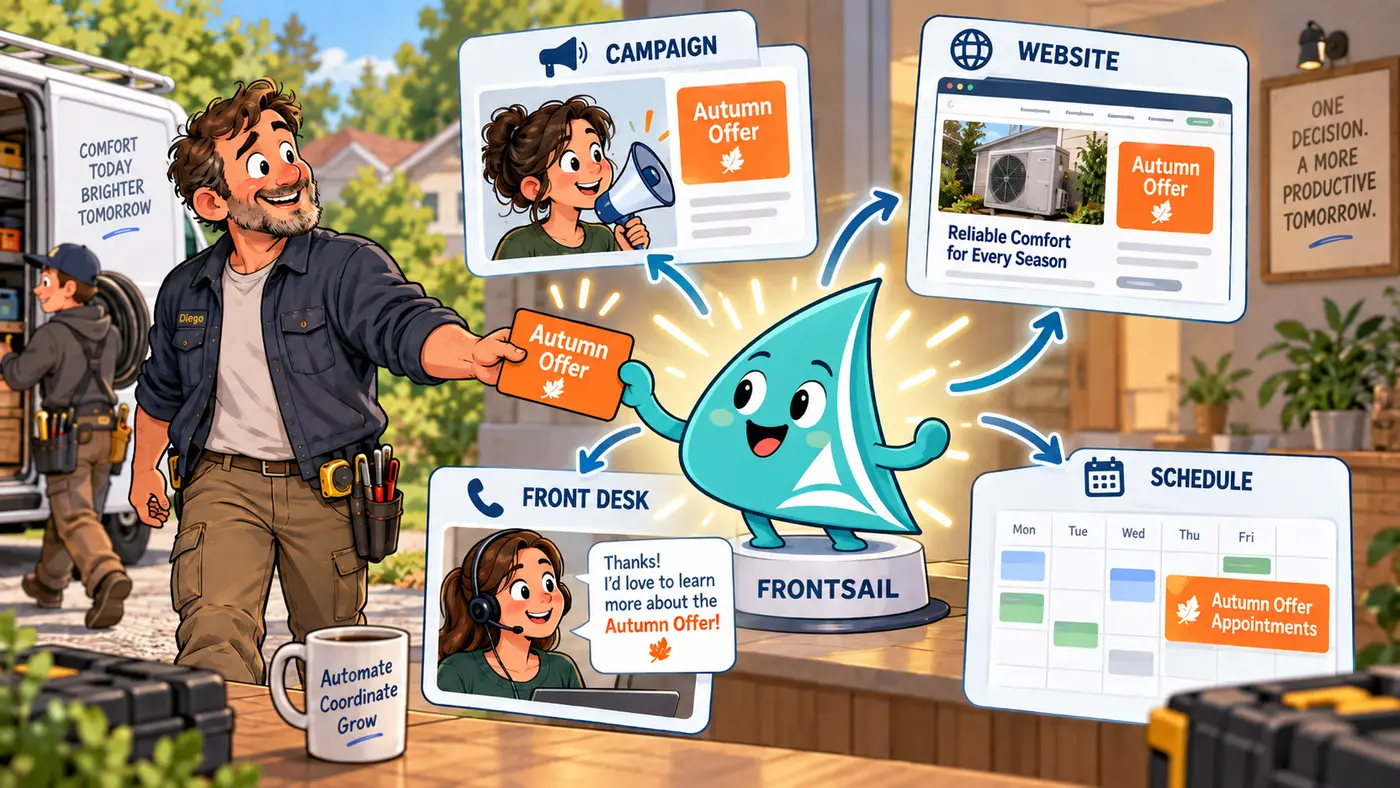
But when you authorize an autumn maintenance promotion, you do not have to personally translate that decision into instructions for each of them. Your assistant coordinates the campaign, website messaging, front-desk information, and booking rules. When the offer expires, the affected channels change together, without erasing commitments already made.
An ad should not promise an offer your receptionist has never heard of.
That is FrontSail AI’s role in this vision: the business-aware operational layer coordinating tools, specialized agents, and people. Not another enormous application that must do everything itself, and not another dashboard where you can admire your unfinished work.
None of this deserves trust merely because the assistant sounds confident. The office must respect permissions, verify outcomes, and make incomplete work visible. A failed calendar update cannot become “All done!” because the sentence sounds nicer.
You need visibility and control. You should not need to supervise every movement.
The real opportunity is bigger than finishing your quotes
Return to that fourth crew.
Hiring more people creates more capacity to perform work. It also creates more scheduling, customer communication, documentation, and decisions.
In the lights-out office model, more activity does not have to mean a matching increase in administration personally handled by you. That could make room to expand, develop your team, improve customer relationships, or finally explore the opportunity you keep postponing.
It does not eliminate the other demands of growth. You still need good people, equipment, cash, and judgment. The heat pump remains inconsiderately heavy.
But your capacity to lead a business no longer has to be tied so tightly to your willingness to process its paperwork at night.
And perhaps you do not want a fourth crew.
Perhaps three crews, good customers, a healthy business, and evenings with your family are exactly what success looks like.
That is not a smaller achievement. It is a different decision.

The most interesting promise of a lights-out office is not that a quote takes fewer minutes to produce.
It is that the owner gains more say over what the business can become, and how much of their life it consumes.
In this series, we will explore that opportunity, the coordination behind it, the risks, and the path from useful assistance to dependable delegation. The accompanying blueprint will bring those pieces together.
For now, the question is simple: what would you do with the capacity?
Build another crew? Serve another town? Spend more time with the people you already employ? Get home before dinner?
Let your ambition, not your paperwork, set the size of your business.
Turn off the first light
A lights-out office starts with one routine you no longer have to run yourself.
FrontSail AI answers the calls and messages your team cannot, captures what the customer needs, and keeps the request moving until somebody owns it. Start there.
Next in the series: why your business should not be limited by your evenings.