You Hired a Second Crew. Why Did You Get a Second Job?
A lights-out office is about more than finishing paperwork faster. It is about how much business you can lead without giving it every available hour.
 The FrontSail AI team8 min read

Part 2 of the Lights-Out Office series.
Picture a heating-and-cooling business taking the next step.
You have enough demand to hire another crew. You find good people, equip another van, and start accepting work you previously had to turn down. This is what growth was supposed to look like.
Then Tuesday arrives.
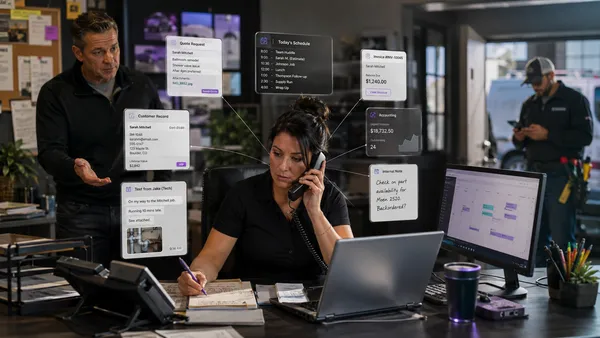
One customer wants a different appointment. A technician needs the latest scope. Someone has approved a quote, but the installation is not scheduled. Yesterday’s photographs are somewhere in a message thread, and three completed jobs are waiting to be invoiced.
The new crew is doing its job. Unfortunately, it has also created another job.
Yours.
You increased your capacity to perform the work. You did not necessarily increase your capacity to keep the work moving.
In the first post, we imagined a lights-out office in 2033. This time, let’s examine the decision that makes that future interesting: how can you take on more business without personally taking on all the administration that comes with it?
The other cost of another van
The van has a price. The equipment has a price. Wages appear in a budget.
The extra coordination is easier to underestimate. It arrives as “just a quick question,” then another, then a conversation you must reconstruct before anyone can proceed.
In this imagined business, the owner is the person who knows what was promised, whether the customer confirmed, and why the schedule changed. More jobs mean more occasions when somebody needs that knowledge.
The tasks themselves are familiar industry concerns. Jobber’s 2026 Home Service Trends Report, based on a December 2025 survey of 1,050 U.S. home-service business owners, found that 40% identified customer communication and 37% quoting among their most time-consuming activities. Those are shares of respondents, not percentages of their working hours.
The proposed lights-out office addresses something beyond the time required to write a quote. It addresses the owner’s continuing responsibility for remembering that the quote needs to move.
There are sensible ways to tackle this already: better processes, capable office staff, and well-configured software. Hiring an administrator can be an excellent decision.
The opportunity we are exploring is to make more of that coordinating capacity available without requiring a person to manually drive every routine step.

The AI race is moving toward delegated work
On October 8, 2026, Google Cloud announced its Gemini agent, describing work that can continue in the cloud across sessions, use business systems, and coordinate multiple agents toward an objective. That is a more substantial ambition than producing a useful answer inside a chat window.
Our interest is not whether another assistant can generate an impressive demonstration. It is whether these capabilities can become dependable enough for a business owner to delegate the administrative work surrounding a job.
An announcement does not establish that this problem is solved. But it makes the next question worth asking:
Could this help you lead another crew? Or would you simply become a faster administrator for two crews?
Those are different outcomes.
A faster quote is useful. A quote you don’t have to chase is different.
Consider two versions of the same afternoon.
In the first, an assistant drafts quotes quickly. You still remember which ones need sending, decide when to follow up, check for replies, update the records, and arrange the next step after acceptance.
You have saved effort inside a task. You still operate the process.
In the lights-out office model, you provide the scope, approved pricing, and relevant agreement. The office carries the authorized workflow forward. It tracks whether the customer has responded, follows the agreed policy, and coordinates what happens next. Missing information or an exception comes back as a specific question.
You still make the decisions that belong to you. You do not have to repeatedly restart the routine work.
That difference matters when you are interviewing a crew leader or helping an apprentice. You should not have to interrupt either conversation to discover whether a routine follow-up happened.
The bigger gain is not simply faster execution. It is work that no longer depends on your repeated attention.
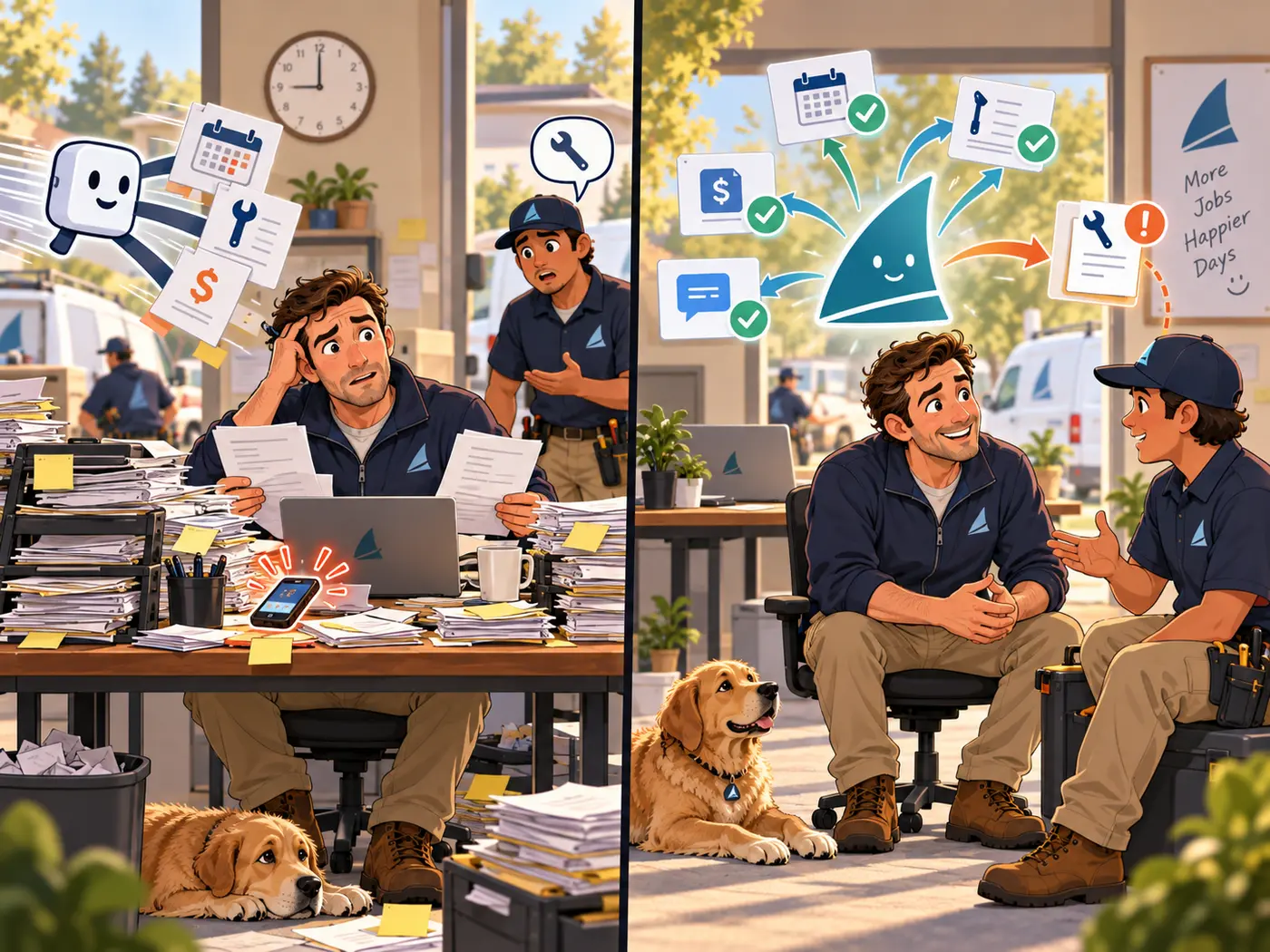
Growth needs your judgment. It should not need every spare minute.
Now return to the second crew.
Suppose a customer’s rescheduling request reaches the office. Within the rules you have established, it checks availability, agrees on a suitable slot, updates the affected records, and informs the people who need to know.
You do not approve each administrative movement. You become involved when the situation exceeds the office’s authority or requires a genuine commercial decision.
The important result is not the calendar entry. It is that you can continue developing the crew leader who will help the business operate well next year.
This is the role FrontSail AI is building toward: the business-aware assistant coordinating work across existing tools, specialized agents, and people. Your accounting platform can remain your accounting platform. A specialist service can perform specialist work. The owner should not have to personally connect every step.
This is a direction for the operating model, not a claim that every office function is already autonomous.
And it does not remove the other demands of growth. More installations still require skilled people, equipment, materials, and commercial discipline. Software has yet to persuade an air conditioner to carry itself upstairs.
The aim is not growth without resources. It is growth without making the owner the administrative connection between everything.
More capacity does not have to mean more business
Perhaps another crew is exactly what you want. Perhaps it is not.
You might prefer to invest the recovered attention in your existing team: better training, better planning, and more time to listen before small frustrations become large ones. You might spend more time with customers whose projects deserve a thoughtful conversation.
Or you might decide that the business already provides enough.
Then the improvement is not another van. It is being able to watch your child’s hockey game rather than answer messages between plays. It is taking a day off without assembling a ceremonial handover of everything stored in your head.
There is no obligation to convert every recovered hour into revenue. Otherwise, we have simply replaced one demanding boss with another, and this one calls itself productivity.
A business can become more capable without becoming bigger.

Count what no longer needs you
There is a practical test underneath this vision.
After introducing an assistant, does the office require less human effort to complete work correctly? Or has the effort merely changed into checking drafts, correcting mistakes, and supervising automations?
Setup, maintenance, and oversight count. So does work quietly shifted to an employee or family member. A busy assistant is not automatically a more capable business.
For the owner, the useful signs are concrete: routine jobs move forward without repeated prompting, fewer loose ends accumulate at night, and additional work does not produce an equivalent increase in personal coordination.
That is the opportunity behind the lights-out office.
You could use it to build a larger business. You could use it to lead the current one better. You could use it to reclaim part of your life.
Your next crew should add capacity to the business, not another shift to your day.
Add a crew, not a shift
Every new crew multiplies the questions, confirmations, and follow-ups that land on you.
FrontSail AI answers the calls and messages your team cannot, captures what the customer needs, and keeps the request moving until somebody owns it. Start with the coordination that grows fastest with every new job.
Next in the series: one decision, an entire office in sync. How separate tools and specialized agents can work as one operation.